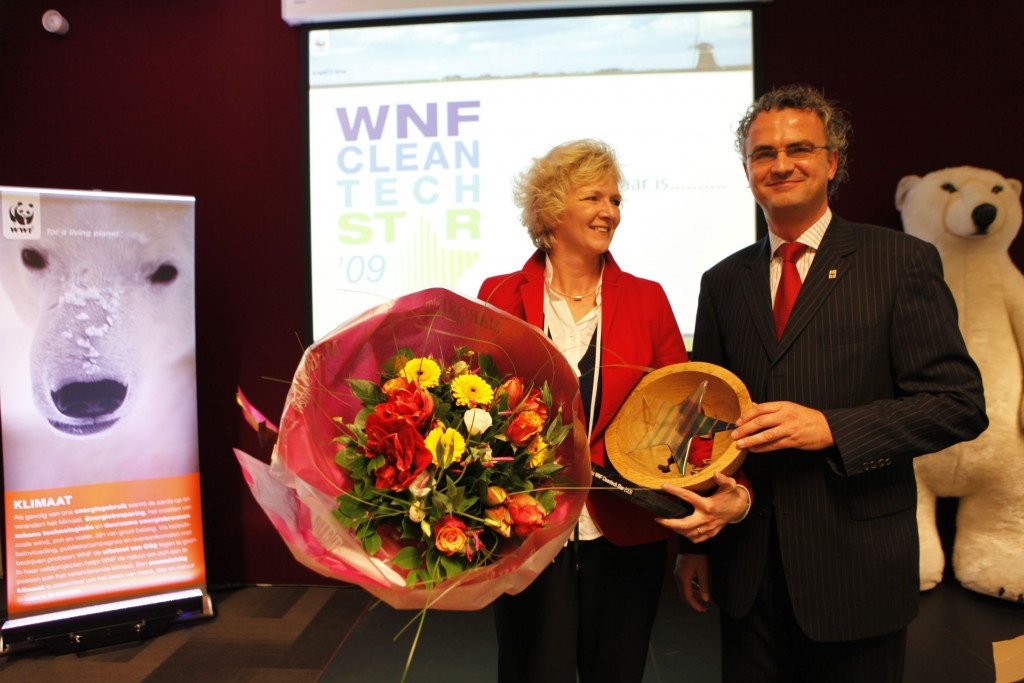
March 2010. The WWF publishes its report “Water – a precious commodity”. After being awarded the Cleantech Star, we obviously look at the WWF’s publications with special attention.
In the report, the water footprint is calculated for a variety of everyday products. The report confirms my view on the future: a shortage of energy will not be the world’s greatest problem, but a lack of clean drinking water!
Types of water
For anyone who has not read the report: hold on tight. For the production of one liter of milk, 1,000 liters of water are required. Water for the cow to drink, water to grow the grass, water to transport the milk, for packaging, etc. Of course, this is not only clean drinking water, it is also ditch water or ground water for irrigation, for example. Therefore, the report identifies three types of water: green, blue and gray water. Green water is groundwater that is withdrawn in a natural way from the soil. Blue water is water extracted for irrigation from groundwater and surface water and gray water is the extra water needed to dilute polluted water so that the water quality is within the set standards.
Irrigation particularly inefficient
In my opinion, the most profit can be obtained from ‘blue water’. Irrigation is generally very inefficient. Seventy-five percent of the water use in the world is used for agriculture, half of which is lost during the irrigation process. That is quite a lot.
A few more numbers: 10 liters of water is needed for the production of one sheet of A4 paper. A cotton t-shirt accounts for 2,700 liters of water. A glass of wine? 120 liters of water. And 15,500 liters of water are used for one kilogram of beef that can be found in the stores. You should say this out loud: fifteen-and-a-half-thousand liters of water… Not very surprising that we consume 2,300 cubic meters of water per person per year. 2.3 million liters. That’s almost a 50 meter Olympic pool full of water! And that times sixteen million inhabitants.
Becoming a vegetarian
Moreover, we use almost twice as much water in the Netherlands as the average citizen in the world (2300 compared to 1243 m3). That this can be done differently is proven by the Germans (1545), the Danes (1440) and the British (1245), while it should not surprise us that it could be even worse: the inhabitants of the United States use 2483 cubic meters of water per inhabitant per year.
Back to the cow. You would be better off eating pork (4,800), goat meat (4,000) or chicken (3,900). Or even better still, of course: become a vegetarian. But then it is better to eat a kilogram of potatoes (900) than a kilogram of rice (3,400), while even producing a slice of brown bread requires 40 liters of water.
Are these figures making you dizzy? They are me. So, enough figures, now we have to do something about it!

